
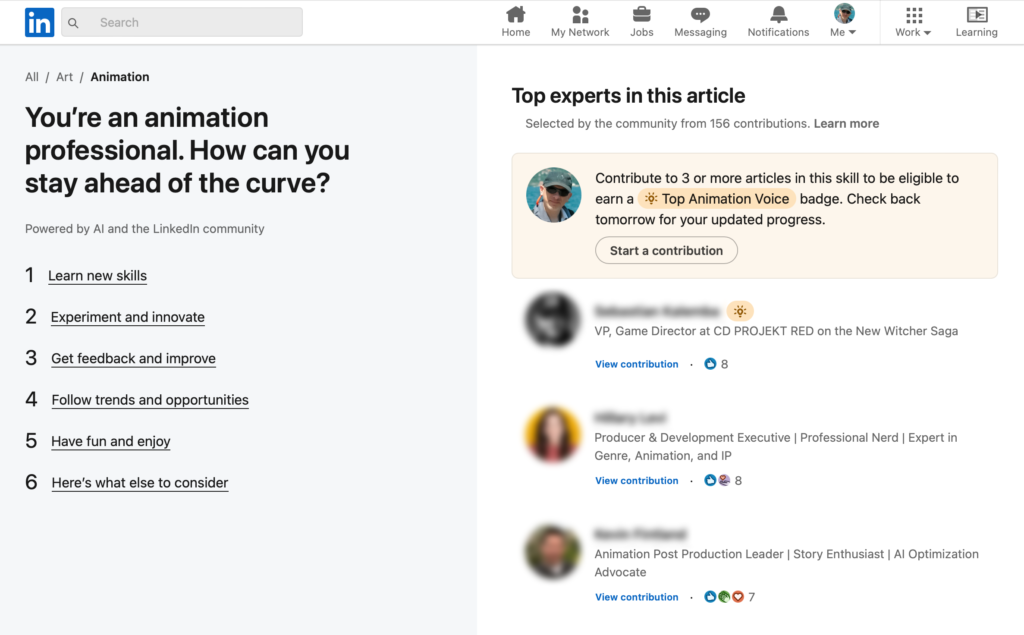
“You’re an animation professional. How can you stay ahead of the curve?“
Dear friends and professional artists in the magic world of animation,
What you read above is the title launched by the LinkedIn team to promote a forum among users that would collect insights, ideas and suggestions regarding the profession of animation, to which I was kindly invited as an “expert” (I think mainly due to the my age).
In general we are living in a complex historical period, to say the least, almost everywhere in the world. I won’t dwell on this, because it would not be the appropriate place, and because I believe that we are all fully aware of it.
Anyway, also as regards animation industry, after a period of somewhat chaotic and in some ways anomalous expansion, we are going through a deep crisis, both on an economic/productive and on a technical/creative point of view.
Precisely for this reasons I feel this reflection very timely, even urgent I could say, in this particular moment, especially for us who have already been working as animators for years, and even more thinking of an new generation of young artists who aspire to conquer their space and to establish themselves through their talent and their wonderful enthusiasm.

So, starting from this initial stimulus – for which I thank LinkedIn and its team – I thought I would publish here in a more extensive and convenient way some of my thoughts, ideas, ruminations on these topics, which I have dealt with all my life. Ultimately, it is a way of making my modest experience available to the community, without pomp or too many pretensions. However, an experience developed over many, perhaps even too many, years of activity in the field.
I will therefore write a series of articles, which I will divide into as many chapters, so as to be able to address the issues that are closest to my heart on this topic in the most concise and usable way possible.
I will mainly deal with the role of the “character animator”, leaving aside (but never forgetting) all the other great talents that contribute to the creation of an animated film, such as background artists, layout artists, character designers, fx animators, storyboard artists, musicians, script writers, and many others.
Many of these roles, among other things, are part of the skills of the animators themselves, who sometimes alternate one role with another, but it is certain that, in the absence of animators, animated cinema simply could not exist.
Moreover, I will also deal a little more with 2D animation, so-called “traditional”, simply because it “came first”.
In the early days of my professional activity John Lasseter was still a young (2D) Disney animator, and 3D CGI was still confined in the ARPA laboratories, in Utah.
But naturally from the (character) animator’s point of view the basic principles are fundamentally the same, so everything I will say here, unless specific purely technical distinctions are made, are applicable to both scenarios, 2D and 3D animation, which are basically the direct filiation of the last from the first.
I finally decided to publish these articles in the form of a blog, because I still consider it the best means to have a non-one-way dialogue with potential readers: I will be certainly glad to replay to anyone who wishes to clarify, disagree, argue, or delve deeper into each of the topics addressed.
Follow me, if you want, in the next article:
Chapter 1
“Animation: Art, craft, or nuts?”